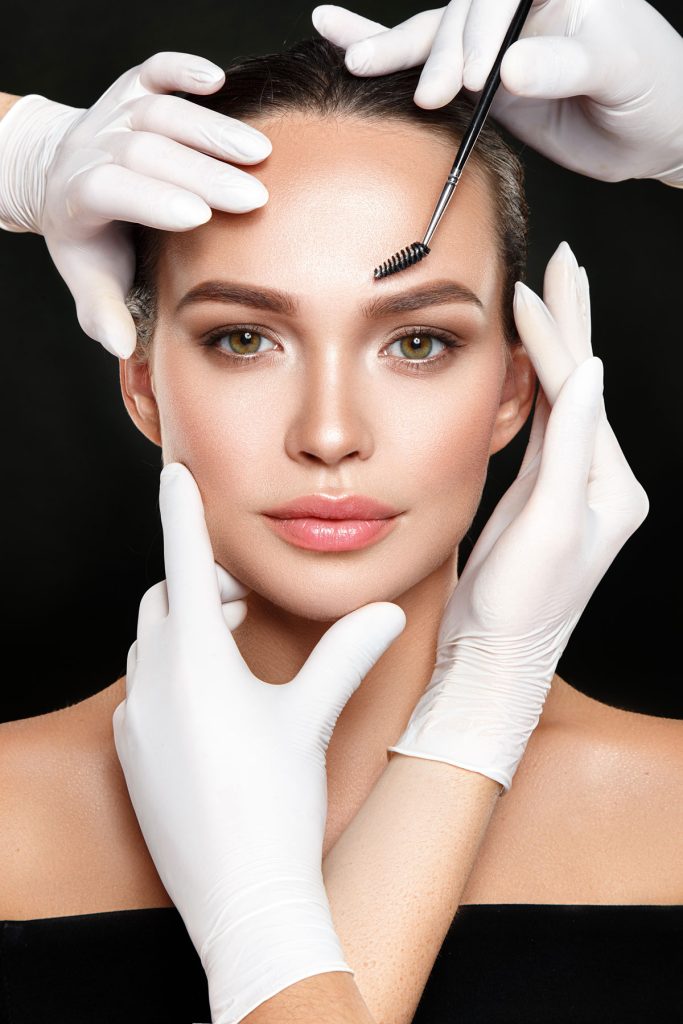
Let’s be honest: when you’re lying on that treatment bed, eyes closed, listening to the soft hum of the machine, you’re probably thinking about how amazing your “after” photo is going to look. You’re likely not thinking about the molecular weight of the liquid being tapped into your dermis.
But here’s the tea, beauties: What’s in the bottle matters just as much as who’s holding the machine. If you’ve ever seen someone with brows that have turned a strange shade of “salmon pink” or “ghostly blue-gray” over the years, you’ve witnessed the battle between organic and inorganic pigments. Today, I’m breaking down the chemistry so you can be the most informed client in the room.

The Contenders: What Are They?
In the permanent makeup (PMU) world, “Organic” and “Inorganic” don’t mean what they mean at the grocery store. It’s not about pesticides; it’s about chemistry.
1. Inorganic Pigments (Mineral-Based)
These are primarily made from iron oxides (Fe2O3) and other earth-derived minerals.
- The Vibe: Earthy, muted, and natural.
- The History: These were the “OG” pigments used in tattooing for decades.
2. Organic Pigments (Carbon-Based)
These are made from carbon chains (C) and synthetic molecules.
- The Vibe: Bright, vibrant, and incredibly saturated.
- The History: These are newer to the PMU scene but have taken over because of their “wow” factor.
The Comparison: A Deep Dive
| Feature | Inorganic Pigments | Organic Pigments |
|---|---|---|
| Particle Size | Large & Heavy | Small & Light |
| Color Intensity | Soft, natural, more matte | Bright, vivid, “lipstick” effect |
| Longevity | Fades faster (1–2 years) | Lasts longer (2–5 years) |
| Fading Style | Tends to fade “warm” (pink/orange) | Tends to fade “cool” (gray/blue) |
| Allergy Risk | Extremely low | Slightly higher (due to complexity) |
Why the Fading Happens (The “Salmon” Problem)
This is where it gets real. Your body is a high-tech machine designed to get rid of foreign objects.
Inorganic (Iron Oxide) Fading: Iron oxide is made of different colors (red, yellow, black) mixed to make brown. Your body loves black and yellow iron oxide, it absorbs it quickly. The red molecules? They are stubborn. This is why inorganic brows often turn that peachy-pink color after a year. It’s just the red molecules left behind!
Organic (Carbon) Fading: Carbon particles are tiny and very stable. However, over years of sun exposure, the warm tones in organic mixes might evaporate, leaving behind the carbon base. This results in that ashy or blue-gray shadow.
Influencer Insight: Neither is “bad,” but an expert artist will choose based on your skin’s undertone. If you have very cool-toned skin, an organic pigment might look too “icy” over time.
Safety, MRIs, and Metal
I get this question a lot: “Will my brows explode in an MRI machine?” Let’s breathe. No. * Inorganics: Because they contain iron oxides (Fe2O3), they are technically metallic. In very rare cases, they can cause a slight “tingling” sensation during an MRI, but modern PMU pigments are formulated to be safe.
- Organics: Since they are carbon-based, they are generally non-reactive in magnetic fields.
Regarding Client Safety, the industry has shifted toward “Hybrid” pigments. Most of the bottles your artist uses are actually a blend of both! This gives us the safety and soft fading of inorganics with the staying power and vibrancy of organics. It’s the “Best of Both Worlds” (shoutout to Hannah Montana).
The “Nano” Factor
For Nanobrows specifically, pigment choice is crucial. Because nano-strokes are so fine, we need a pigment that won’t “blur” or “migrate.”
- Organics are often preferred for nano because the small particle size flows easily through the tiny needle, creating those crisp, hair-like lines.
- Inorganics are sometimes added to the mix to ensure the color stays “grounded” and doesn’t look like a neon sign.
The Final Word
At the end of the day, you don’t need to choose your pigment, you need to choose an artist who understands the science of their kit.
Ask them: “Do you use organic, inorganic, or hybrid pigments, and how do you expect them to fade on my specific skin type?” A pro will love that you asked!
Disclaimer: This post is for educational and aesthetic inspiration. I am a beauty expert, not a chemist or doctor. Always consult with a licensed, certified PMU professional and disclose any metal sensitivities or allergies before your procedure. Have questions, fill out your consultation form here.
Do you prefer a brow that fades away completely so you can change your look, or are you looking for maximum staying power? Let’s talk pigments in the comments!
Leave a Reply