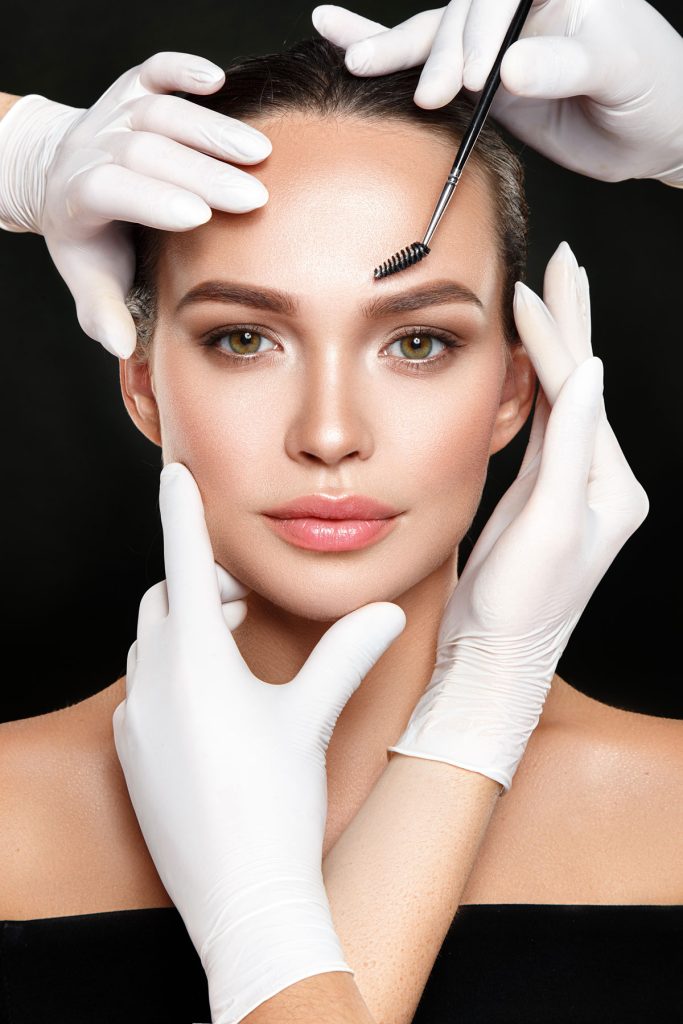
So, you finally did it. You pushed through the “healing ghost phase,” you’ve survived the scabbing, and now your powder brows are healed, pixelated, and perfect. You’re living your best low-maintenance life, until you realize your nightly 10-step skincare routine might be an accidental “assassin” for your new pigment.
We all know the basic “don’t put retinol on your brows” rule, but if you want your investment to last 2 years instead of 6 months, we need to go deeper. Today, we’re looking at the labels on your vanity and learning how to navigate the “Danger Zone” without sacrificing your glow.
Grab a coffee (or a green juice, we’re being that girl today), and let’s talk chemistry. ☕🧪
The Science of the “Fade”
Your powder brows live in the upper layer of the dermis. Your skincare, however, is designed to work on the epidermis (the surface) to speed up cell turnover. When we use products that encourage the skin to “refresh” itself faster, the skin essentially tries to “push out” the pigment particles as if they were debris.
The goal? Keep your skin glowing around the brows, while keeping the brow area in a state of “pigment-preserving stasis.”

The Sneaky “Pigment Assassins” (Beyond Retinol)
Most artists mention AHAs and Retinoids, but there are some low-key ingredients in your serums that could be muting your brows every single night.
1. The Brighteners (Vitamin C & Beyond)
We love Vitamin C (C6H8O6) for that “lit from within” look. However, L-ascorbic acid and other brighteners like Kojic Acid, Tranexamic Acid, and Licorice Root are designed to break down melanin and lighten hyperpigmentation.
- The Risk: They don’t always distinguish between a dark sunspot and your brow pigment. Over time, these can turn your beautiful brown brows into a dull, ashy gray.
2. The Acne Combatants (Benzoyl Peroxide)
If you’re still fighting the occasional breakout, be careful with Benzoyl Peroxide (C14H10O4).
- The Risk: This ingredient is literally a bleaching agent. If you’ve ever had it bleach your pillowcases or towels, imagine what it’s doing to your tattoo. It can drastically shift the color of your pigment in just a few applications.
3. The Mechanical Exfoliants
I’m looking at you, Clarisonics, scrubby mitts, and walnut scrubs.
- The Risk: Physical exfoliation manually thins the skin over the pigment. The thinner the skin, the faster the pigment is exposed to the elements and sheds away.
The “Skincare vs. Brows” Cheat Sheet
| Ingredient Type | Impact on Powder Brows | Best Practice |
|---|---|---|
| Retinoids (Tretinoin, Retinol) | High Risk: High cell turnover = rapid fading. | Keep at least 0.5 inches away from brow border. |
| AHAs/BHAs (Glycolic, Salicylic) | Moderate Risk: Chemical exfoliation fades edges. | Apply with a Q-tip to avoid “migration” into brows. |
| Vitamin C / Brighteners | Low-Moderate Risk: Can dull/shift pigment color. | “Halo” application only. |
| Hyaluronic Acid / Squalane | Safe: Hydration actually makes pigment look “crisp.” | Apply freely! Hydrated skin = better-looking pixels. |
| Benzoyl Peroxide | High Risk: Can bleach or shift color. | Spot treat only; keep far away from the brow line. |
The “Halo” Application Technique 😇
How do you actually apply your expensive serums without ruinous “brow creep”? You use the Halo Method.
- The Barrier: Before applying active serums (like Tretinoin or Glycolic acid), apply a thin layer of a neutral occlusive, like Aquaphor or a thick lip balm, over your brows. This acts as a “shield” against migrating products.
- The One-Finger Rule: Leave a “halo” of about half an inch of bare skin around your eyebrows when applying actives.
- The Directional Swipe: Always swipe your products away from the brows, never toward them. This prevents you from accidentally pushing that 10% Vitamin C serum right into your arches.
The Sunscreen Sermon ☀️
I will say this until I’m blue in the face: Sun is the #1 killer of PMU. UV radiation breaks down the chemical bonds of the pigment through a process called photodegradation.
- Mineral is Queen: Look for a dedicated brow SPF or a mineral stick (Zinc Oxide/Titanium Dioxide). Mineral sunscreens sit on top of the skin and reflect light, providing a physical shield for the pigment.
- The “Clear Gloss” Trick: If your mineral SPF leaves a white cast on your brow hairs, use a clean spoolie with a tiny bit of clear brow gel to brush through the hairs and “lift” the white residue off.
Besties, Let’s Recap!
You don’t have to choose between “Good Skin” and “Good Brows.” You just have to be intentional. Keep your hydration (Hyaluronic Acid, Ceramides) close, and your exfoliants (Retinols, Acids) at a distance.
Pro Tip: If you notice your brows are looking a bit “gray” or “flat,” try a gentle, non-acidic hydrating mask. Often, it’s just dry skin sitting on top of the pigment, making it look duller than it actually is! Ready to BOOK?
Disclaimer: I am your beauty-obsessed peer, not a dermatologist or a chemist! Always check with your specific PMU artist before changing your routine, as different pigment brands can react differently to certain chemicals.
Do you have a “holy grail” product that you’re terrified to use near your brows? Drop the name in the comments and let’s look at the ingredients together! 👇✨
Leave a Reply